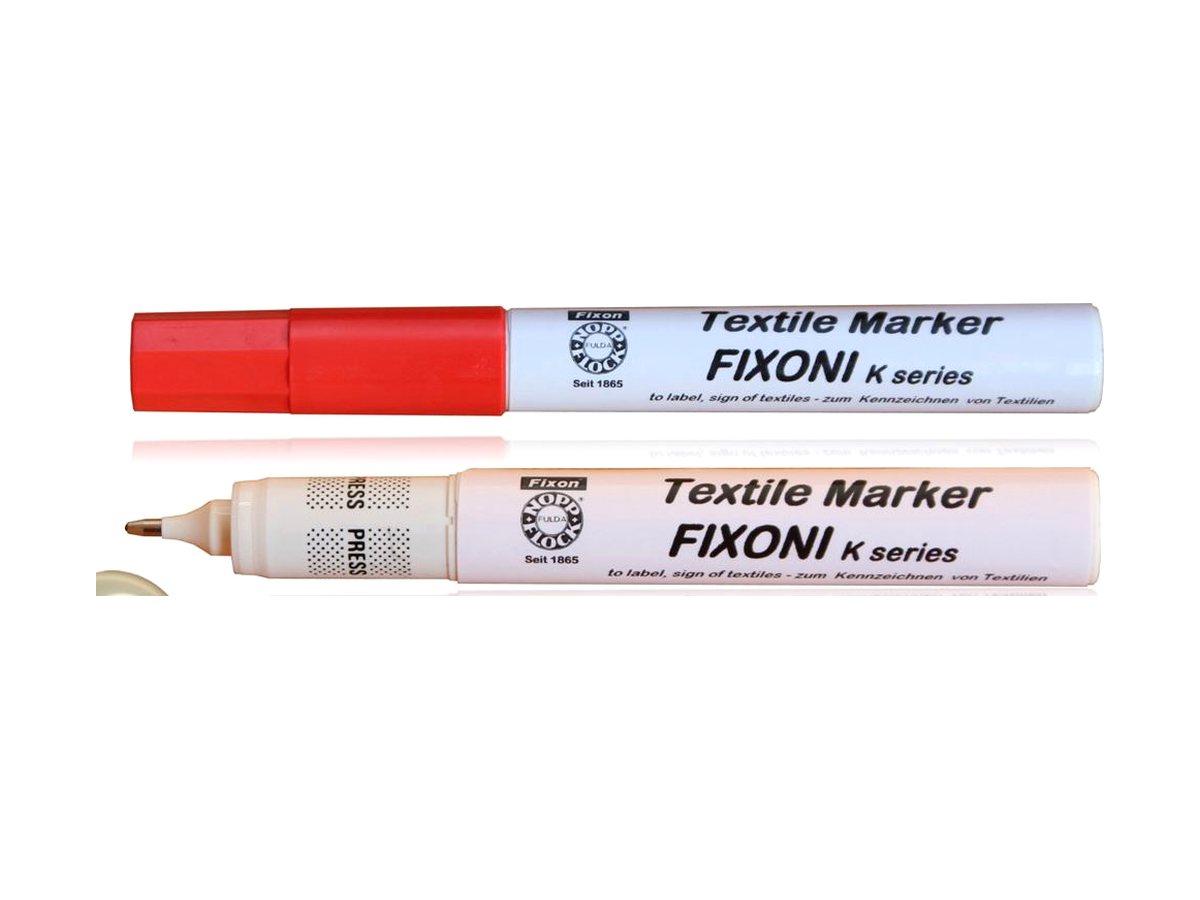
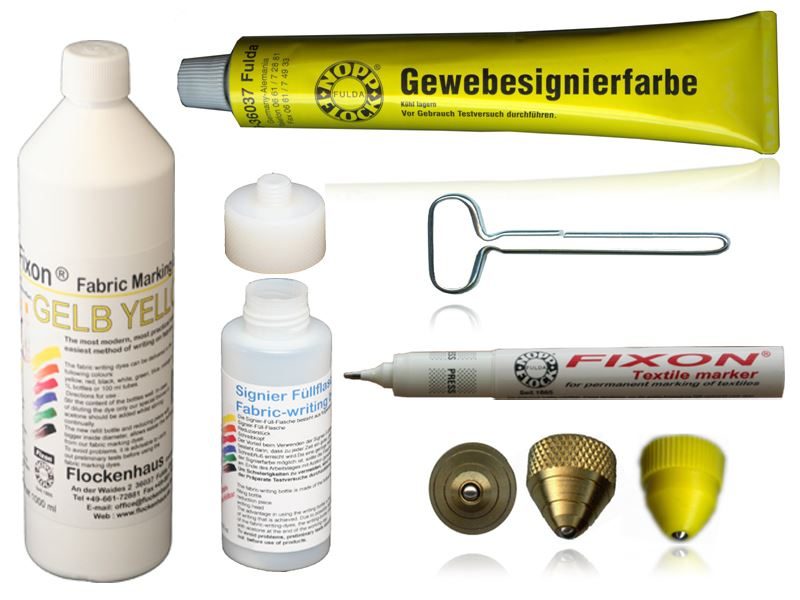
FIXON Textile Marker is the most modern, most practical and easiest method of writing on fabrics.
Fabric-writing dyes make the time-consuming sewing-in of piece numbers unnecessary.
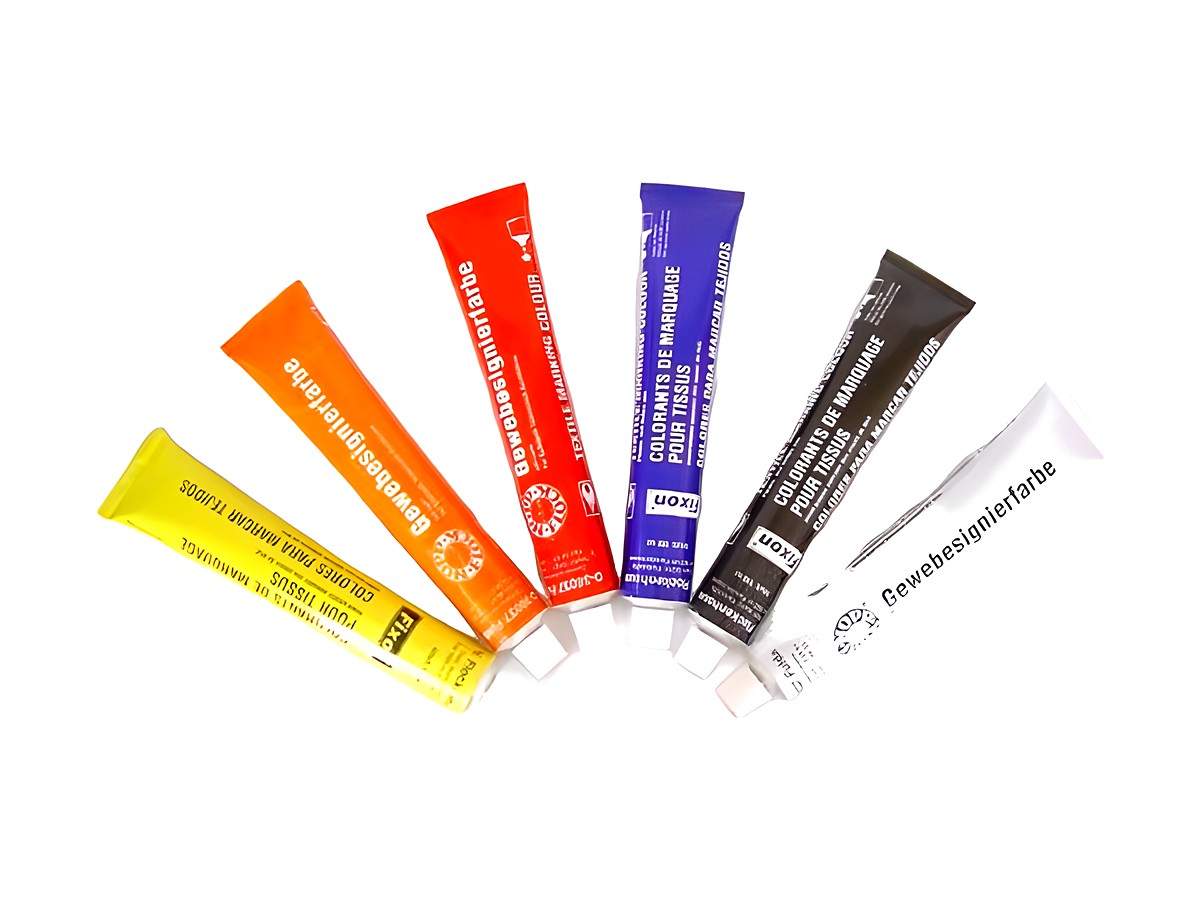
FIXON Textile Marker is available in the following colours: white, yellow, orange, red, blue, green and black. The range of colours allows goods to be marked by quarter or by customer group.
Chemical resistance
FIXON Textile Marker is chemically stable against:
- organic acids
- boiling in 30% caustic soda solution
- boiling in 20% sulphuric acid
- high temperatures up to 220 °C
- washing in soda/soap solutions
- peroxide and chlorine bleaching
- thermofixation
- cylinder presses
- HT dyeing machines, etc.
Versions
FIXON Textile Marker in 100 ml tube | 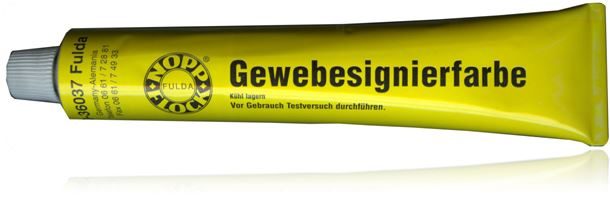 |
FIXON Textile Marker fabric-writing bottle P100 (new) | 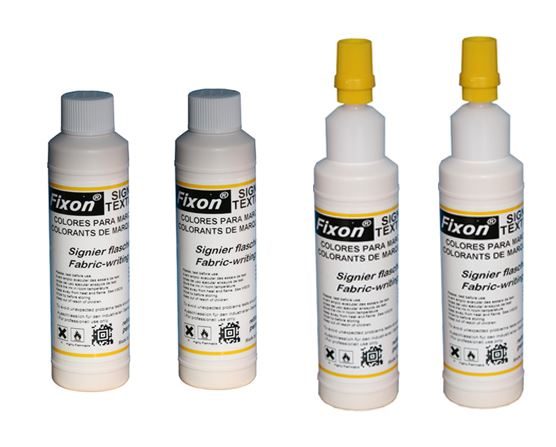 |
FIXON Textile Marker in 1000 ml bottles | 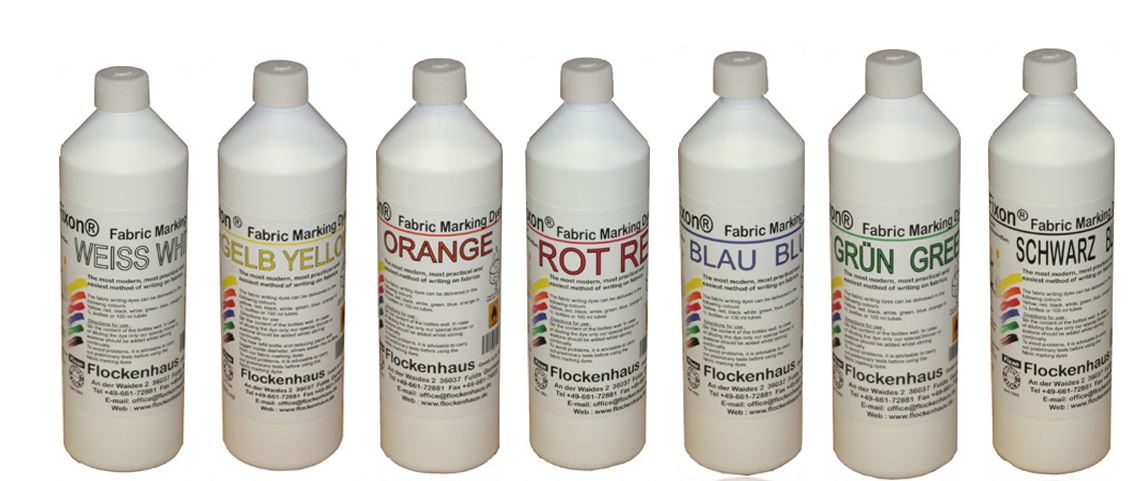 |
FIXON Textile Marker in fillable fabric-writing bottle | 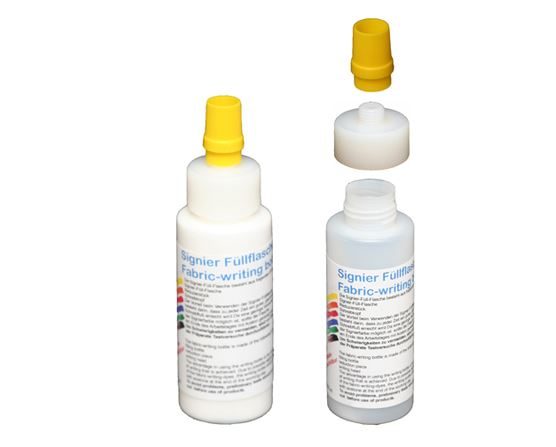 |
FIXON® Textile Marker in tubes
Tubes and fabric-writing bottles are used with writing heads.
Technical tip: The writing heads are very easy to dismantle. We recommend cleaning them with our FIXON cleaning agent. After cleaning, the writing heads can be used again, which saves you money.
FIXON® fabric-writing bottle P100
The FIXON fabric-writing bottle P100 is our new, handy and refillable marking bottle for textiles – a useful, economical and environmentally friendly solution for a wide range of applications.
Available in white, yellow, orange, red, green, blue and black. Content: 100 ml.
Application
Hold the FIXON fabric-writing bottle P100 vertically and apply it to the surface to be marked with even pressure. Clean the writing tip after every use.
The marking bottle can be reused when refilled with our special FIXON Textile Marker colours.
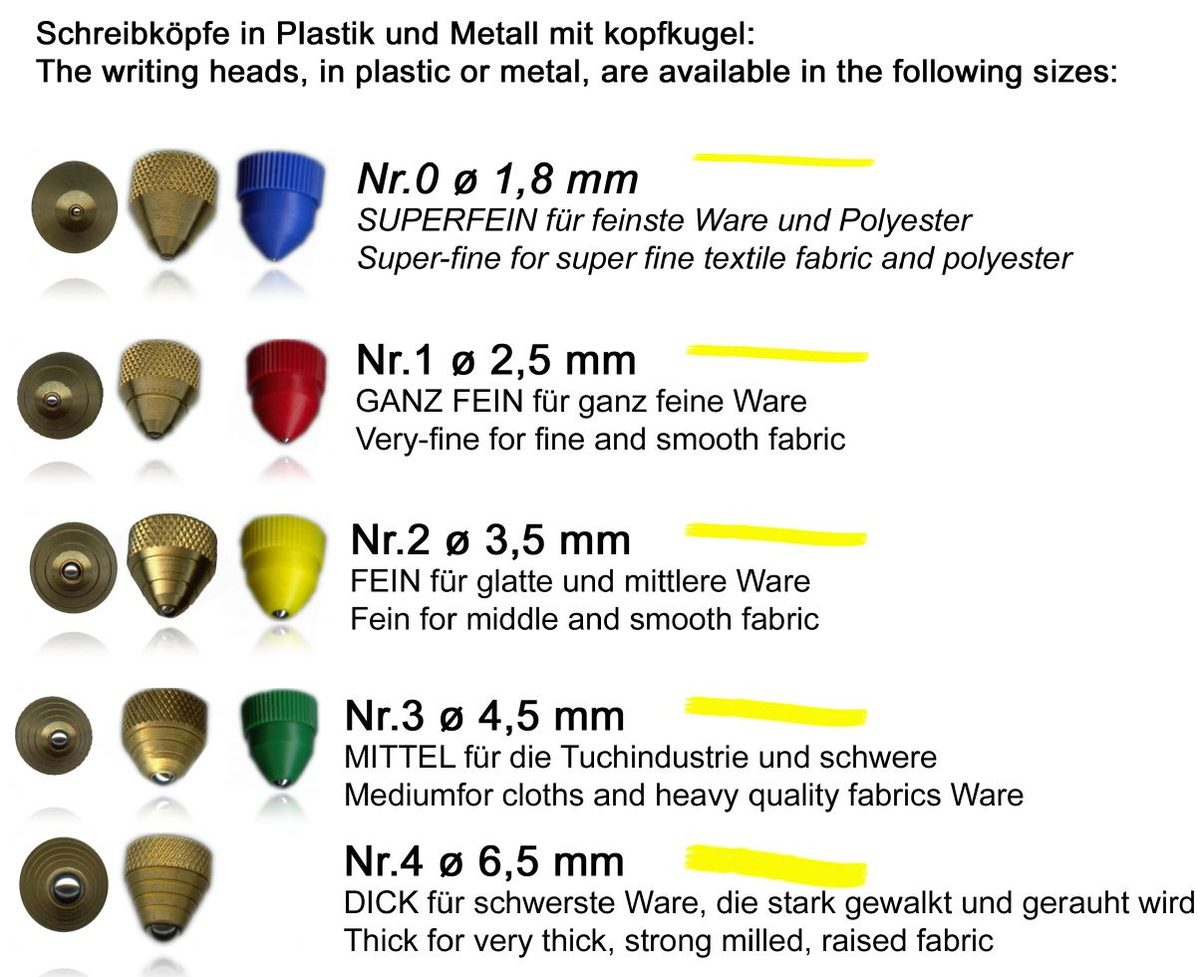
FIXON® Textile Marker in bottles
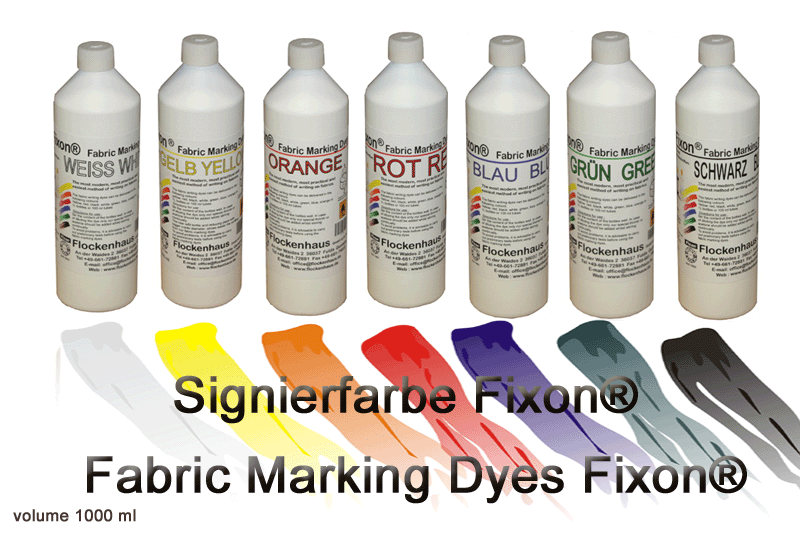
The writing heads are very easy to dismantle. We recommend cleaning them with our cleaning agent. After cleaning, the writing heads can be used again, which saves you money.
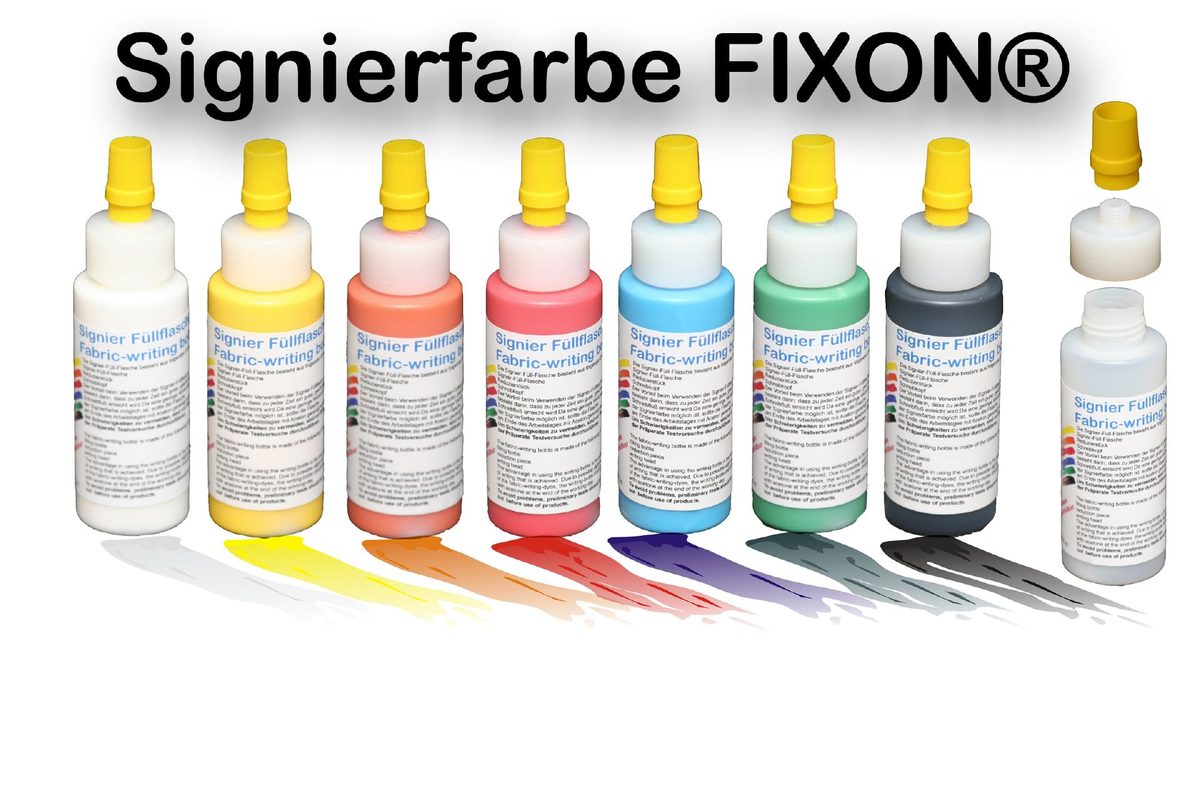
The fabric-writing bottle consists of the following components:
- fillable fabric-writing bottle
- reducing piece
- writing tip
All parts are available separately. The advantage of the fillable fabric-writing bottle is a permanently even writing flow. Fillable fabric-writing bottles are supplied empty.
Technical tips
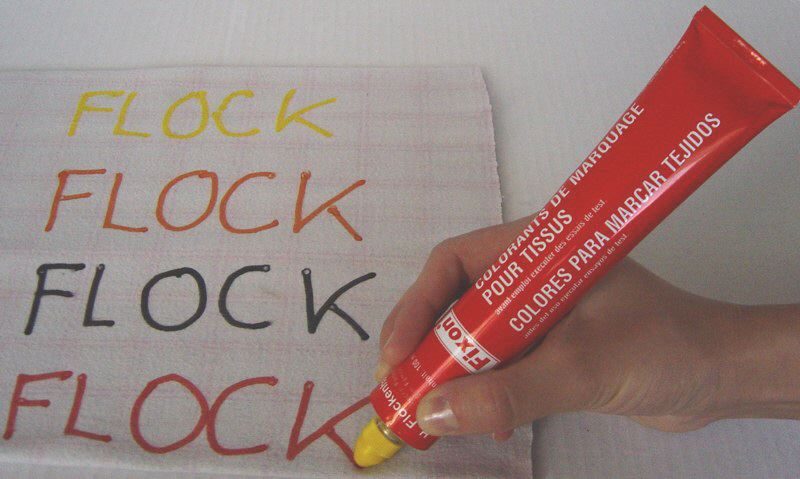
The writing head is screwed onto the tube and remains there until the tube is empty. Only then is it quickly screwed onto a new tube.
Please note: the higher the proportion of synthetic fibres in a product (blended or 100% synthetic), the finer the writing tip must be. The finer the product, the finer the tip.
- Always write on dry products. The fabric-writing dyes cannot bond with wet or damp fibres.
- The fabric-writing dye must be completely dry before the next process step begins. The dyes generally contain organic solvents that evaporate quickly, so a drying time of five minutes is sufficient.
- Store the fabric-writing dyes at normal temperatures, i.e. neither too hot nor too cold. Cold makes the colours thick, heat makes them too thin.
- The range of colours – yellow, red, orange, black, white, green and blue – makes it possible to mark or label products by quarter or by customer group.
- Flockenhaus offers five writing heads:
- No. 0 – super fine, for the finest products
- No. 1 – very fine, for the silk industry and for very fine cotton and polyester goods
- No. 2 – fine, for all smooth fabrics in the cotton and cloth industry
- No. 3 – medium, for cloth and heavy goods
- No. 4 – thick, for the heaviest, strongly milled and raised goods
- The writing head stays on the tube until the tube is completely empty. Only then is it quickly screwed onto a new one.
- If the writing head does not write immediately, scratch off any colour residue with your fingernail. Press the head slightly inwards and squeeze the tube, letting a few drops of dye run out. The tube is then ready for use again.
- If the writing head unexpectedly does not write, unscrew it and replace it with a new one. Place the clogged head in FIXON cleaning agent. After a short time the dye residue is dissolved. The writing head can then be blown through or dismantled and cleaned. Once reassembled, it is in perfect working order again.
To avoid problems, we recommend carrying out preliminary tests before using the fabric-writing dyes.